
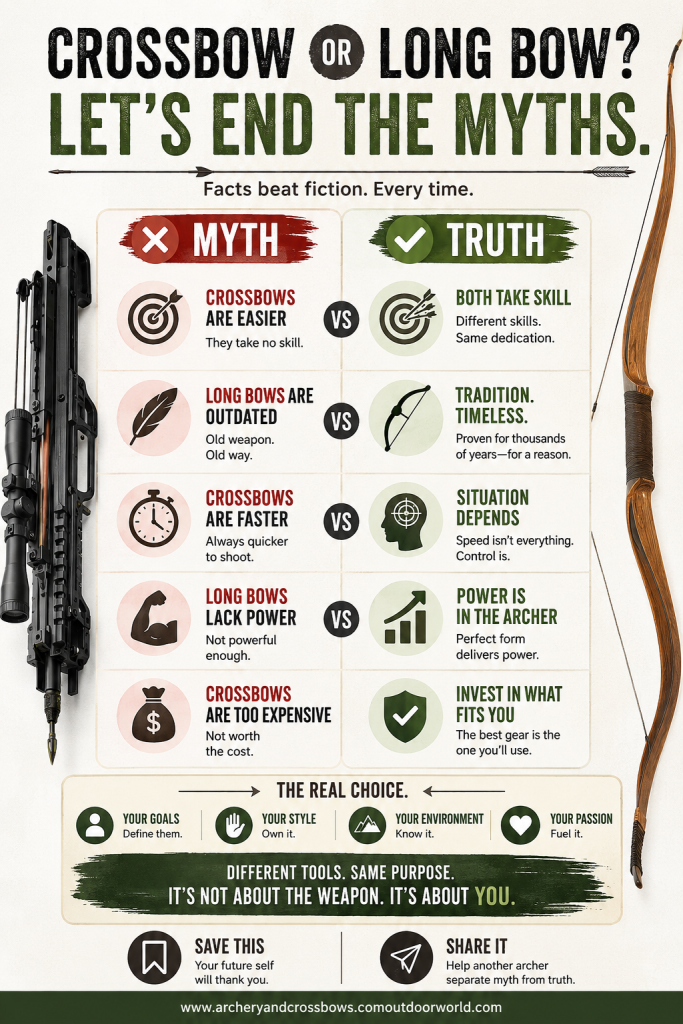
TITLE OPTIONS:
- Crossbow vs Longbow: 10 Questions That Reveal the Better Choice
- Think the Crossbow Is Superior? Answer These 10 Questions First
- The Crossbow or Longbow Debate: A Simple Logic Test Most People Fail
Crossbow or Longbow: 10 Questions That Lead You to the Answer
Most people think the answer is obvious.
A crossbow looks more powerful. More modern. More accurate.
A longbow looks simple. Almost primitive.
So if you asked a beginner which weapon they would choose, many would point to the crossbow before learning anything else.
But what if that first impression is wrong?
Let’s start with the most skeptical person possible.
Who Is Most Likely to Disagree?
Picture someone who has never used either weapon.
Maybe they have seen movies, video games, and online clips.
They believe a few things:
- More technology means better performance.
- More power means better results.
- Easier to use means superior.
- Military adoption proves quality.
- Old tools get replaced for a reason.
Their main objection is simple.
“If the longbow was better, why did people invent the crossbow?”
That sounds reasonable.
Now let’s walk through ten questions.
Answer each one honestly.
See where the logic takes you.
Question 1: What Is the Actual Goal?
Before comparing tools, shouldn’t we define success?
If two people argue about cars, the answer changes fast.
A race car wins on a track.
A pickup truck wins on a farm.
A family van wins for school runs.
So what is the goal here?
Are we talking about:
- Hunting?
- Warfare?
- Sport?
- Training?
- Historical effectiveness?
- Personal skill development?
Can one weapon be “better” without first defining the job?
If not, then any blanket statement already falls apart.
Question 2: If a Tool Requires Less Training, Does That Make It Better?
Imagine two people.
One learns a skill in one week.
The other learns a skill in five years.
The first person reaches acceptable performance quickly.
The second eventually reaches extraordinary performance.
Which system is better?
A calculator is easier than learning mental math.
That does not mean mental math has no value.
The crossbow was famous because it reduced training demands.
A farmer could become useful much faster.
A longbow often required years of practice.
So here’s the question.
Does faster learning automatically equal greater capability?
Or does it simply mean easier access?
Those are not the same thing.
Question 3: Why Did Medieval Armies Love Crossbows?
Many people stop thinking here.
They assume military use settles the debate.
But armies do not always choose what is best.
They often choose what is practical.
Suppose you need 10,000 soldiers.
Would you rather train them for weeks or years?
Would you rather replace casualties easily or struggle to find experts?
The crossbow solved a manpower problem.
That was a huge advantage.
But does solving a training problem prove superior battlefield performance in every situation?
Not necessarily.
Question 4: What Happens When Speed Matters?
Imagine two archers.
One fires a bolt.
The other fires several arrows in the same time.
Which has the advantage?
The answer depends on circumstances.
A single powerful shot can matter.
But so can volume.
History gives us many examples where large numbers of arrows changed battles.
A weapon that fires faster creates more chances.
More chances create more pressure.
More pressure creates mistakes.
So ask yourself this.
If two weapons hit hard, but one fires much faster, should firing speed be part of the discussion?
Of course it should.
Question 5: Which Weapon Depends More on the User?
This question gets interesting.
A crossbow stores energy mechanically.
The user aims and releases.
A longbow relies much more on human ability.
Strength matters.
Technique matters.
Timing matters.
Practice matters.
Now ask yourself something.
If a weapon allows a highly skilled person to achieve much greater results, is that a weakness or a strength?
Some will call it a weakness.
Others will call it potential.
The answer depends on what you value.
Question 6: What Are You Really Admiring?
Think about elite athletes.
Most people admire mastery.
Not convenience.
Nobody watches a professional golfer because golf is easy.
Nobody respects a concert pianist because piano takes little practice.
The achievement matters because the skill requirement is high.
So when people admire legendary longbowmen, what are they actually admiring?
The wood?
The string?
Or the years of discipline behind every shot?
If the skill is part of the weapon’s value, then the conversation changes again.
Question 7: If Power Is Everything, Why Don’t We Use the Heaviest Weapons Possible?
Many people assume more power ends the debate.
But every tool involves trade-offs.
A heavier hammer hits harder.
A lighter hammer swings faster.
A larger truck carries more cargo.
A smaller car uses less fuel.
Nothing exists without compromise.
Crossbows often delivered impressive force.
Nobody disputes that.
But force is only one factor.
Weight matters.
Reload speed matters.
Mobility matters.
Fatigue matters.
So shouldn’t we judge the entire system instead of one statistic?
That seems more reasonable.
Question 8: Which Weapon Creates Better Archers?
This question rarely gets asked.
Yet it might be the most important.
Imagine training for ten years.
Would you become more physically capable through longbow practice?
Almost certainly.
Longbow use develops:
- Strength
- Coordination
- Body control
- Consistency
- Focus
A crossbow develops different skills.
Both have value.
But if the goal is personal growth, which path demands more from you?
And which path gives more back?
That question deserves thought.
Question 9: What Has Survived for Hundreds of Years?
People often assume newer replaces better.
History says otherwise.
Consider knives.
Consider hammers.
Consider ropes.
Many ancient tools remain useful today.
Why?
Because effectiveness does not expire.
The longbow remains popular among traditional archers.
Historical enthusiasts still study it.
Competitions still feature it.
Craftsmen still build it.
If it were completely outclassed, why would serious people keep returning to it?
Maybe there is something there worth preserving.
Maybe usefulness is not measured only by convenience.
Question 10: What Are You Optimizing For?
Now we arrive at the key question.
When you compare a crossbow and a longbow, what outcome matters most?
If you want:
- Easier learning
- Less physical effort
- Faster initial accuracy
The answer points one way.
If you want:
- Greater skill development
- Faster shooting
- Deep mastery
- Traditional archery experience
The answer points another way.
Can one weapon win every category?
No.
That is impossible.
Every comparison involves trade-offs.
The real mistake is pretending those trade-offs do not exist.
The Conclusion You Probably Reached Yourself
Let’s review.
A crossbow is not automatically better because it looks more advanced.
A longbow is not automatically better because it requires more skill.
The right answer depends on the result you want.
But if you followed each question carefully, one thing becomes hard to deny.
The longbow offers something the crossbow cannot.
It turns the archer into part of the weapon.
Every shot reflects training, strength, discipline, and practice.
The crossbow reduces human demands.
The longbow rewards human development.
That is why the debate has survived for centuries.
People are not just comparing weapons.
They are comparing philosophies.
One values convenience.
The other values mastery.
And once you see that difference, choosing between a crossbow and a longbow becomes much easier.
So ask yourself one final question:
Do you want the tool to do more of the work?
Or do you want to become the person capable of doing it yourself?
Your answer determines everything.